

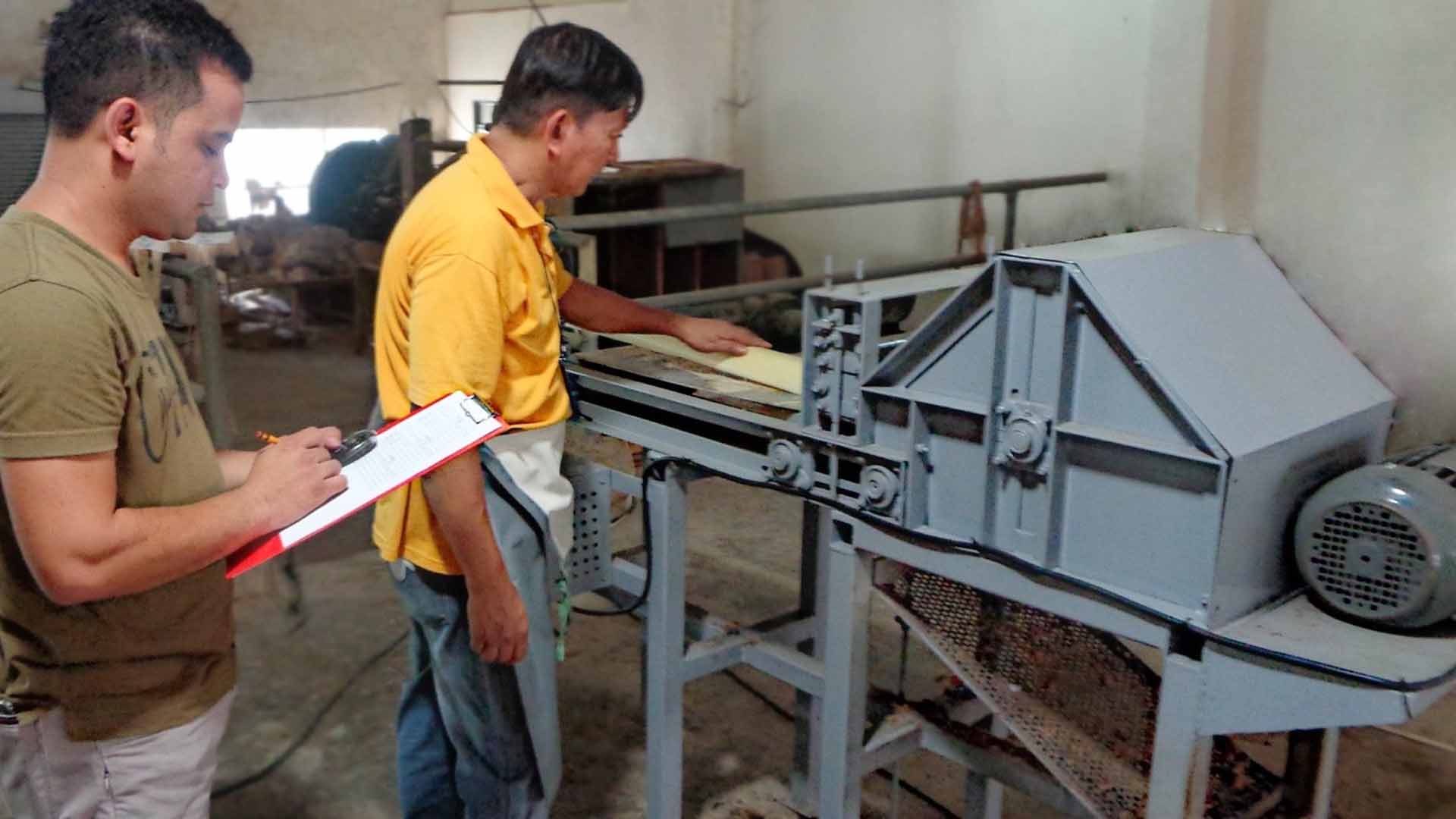






The Department of Science and Technology – Forest Products Research and Development Institute (DOST-FPRDI) has finally come up with a solution to one of our abaca farmers’ biggest concerns: a fiber-extracting machine that is both safe and effective.
According to the DOST-FPRDI’s Engr. Edward Paul S. Marasigan, “For a long time, many of our abaca farmers have had no choice but to use very hazardous fiber-extracting machines that expose them to moving blades. With the Institute’s abaca decorticating machine, this hazard has been removed while still giving them high fiber quality and yield. This is an important development, especially since abaca is one of the country’s most vital cash crops and top export earners.”
Known as the world’s strongest natural fiber, abaca provides income to 76,000 farmers and tens of thousands of other Filipinos working in trading posts and processing plants. Fiber exports and manufacture of abaca cordage, yarns, fabrics and fiber crafts, as well as pulp and raw fiber, earn about USD 97 million per year.
According to Marasigan, “Coming up with a safe and effective fiber-extracting device has been a long-time challenge for the country’s abaca industry. Available technologies are typically labor-intensive, unsafe to use, and unable to yield fibers of consistent quality. We are glad we have been able to develop a machine that solves these concerns. At a fabrication cost of PhP 165,000 and a fiber recovery of 3.79%, our innovation is at par with the abaca decorticating devices available in the market.”
The project was funded by the DOST-FPRDI and an output of Marasigan’s MS in Agricultural Engineering thesis at the University of the Philippines Los Baños. His co-workers included Dr. Fernando O. Paras Jr., For. Victor G. Revilleza and Engr. Alvin F. Vardeleon.